Overview
During my internship at Trystar, I worked on a range of engineering projects supporting the manufacturing of industrial power equipment. My work spanned mechanical design, safety engineering, supplier transition support, and process optimization.
Unlike purely observational internship roles, this position involved ownership of projects that moved into implementation, requiring collaboration with manufacturing, sourcing, production scheduling, and engineering leadership.
The common thread across these projects was practical engineering: identifying bottlenecks, designing around real manufacturing constraints, and delivering solutions that improved safety, throughput, or repeatability.
Safety Guard Redesign for Wire Crimping Stations
Following a workplace injury involving one of the wire crimping stations, I was tasked with developing an operator safety solution that reduced risk without disrupting production efficiency.
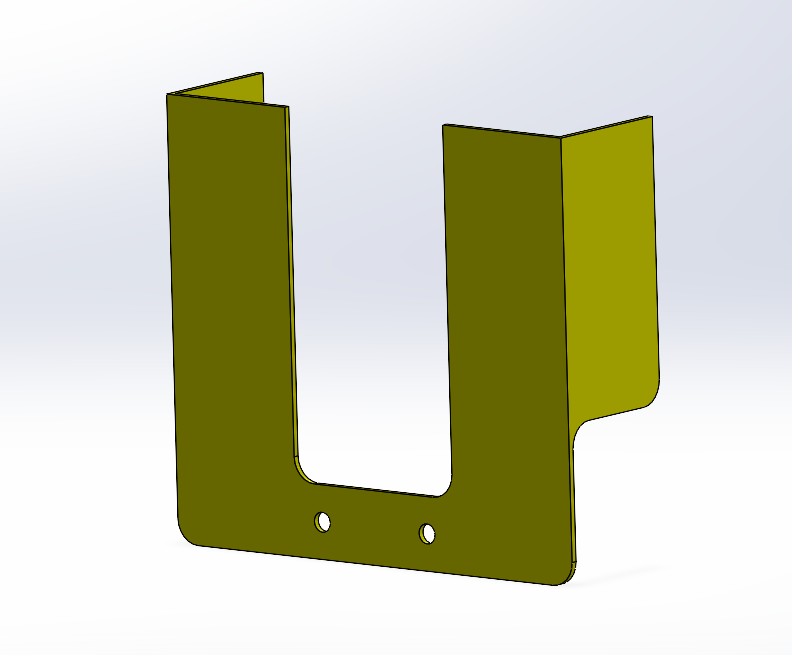
The challenge was balancing protection with usability. A guard that slowed operators or interfered with normal workflow would likely be bypassed or rejected entirely.
I modeled several design concepts in SolidWorks before prototyping the final solution using additive manufacturing. The final guard design was installed across three crimping stations and maintained normal operator access while introducing a physical safety barrier around the hazardous motion path.
This project reinforced the importance of designing for human behavior, not just mechanical functionality.
Engineering Focus
- Human-centered mechanical design
- Rapid CAD iteration
- 3D printed prototyping
- Safety constraint-driven design
- Design validation through operator usability feedback
Powder Coat Baking Rack Redesign
One production bottleneck at Trystar involved the powder coating process, where existing rack geometry limited the size of panels that could be processed and created usability frustrations for operators during loading and transport.
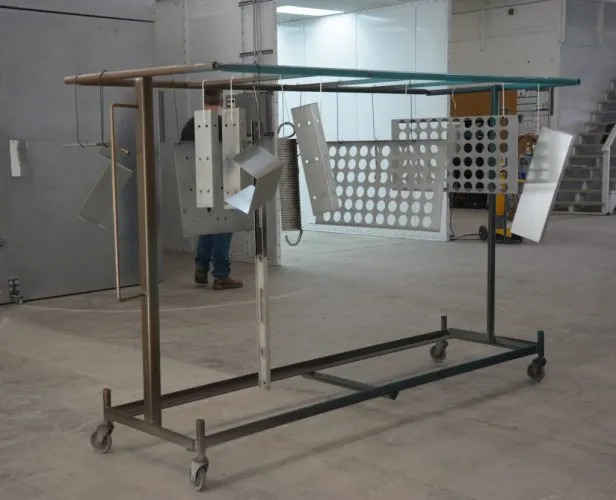
Reference image adapted from Reliant Finishing Systems.
Rather than simply scaling the existing design, I approached the project as a full fixture redesign. I worked directly with operators to understand workflow pain points, handling difficulties, and ergonomic concerns that affected day-to-day usability.
Based on this feedback, I redesigned the rack geometry to increase usable envelope dimensions by 15.7%, allowing larger panels to be processed while also improving operator interaction through more practical handling features, including repositioned handles for better ergonomics during movement and loading.
Because the rack would routinely carry heavy suspended parts in production, I validated the redesign structurally using finite element analysis under a conservative worst-case loading scenario to ensure adequate strength and safe operation.
This project highlighted how effective manufacturing design requires balancing throughput, structural integrity, and operator usability rather than optimizing for a single metric.
Engineering Focus
- Welded fixture redesign
- Human-centered manufacturing design
- Ergonomic design improvements
- Finite element structural validation
- Worst-case load case analysis
- Throughput optimization
- Design for manufacturability
Heat Sink Supplier Transition and Drawing Modernization
I supported a make-vs-buy evaluation for Trystar’s six highest-volume aluminum heat sinks, analyzing internal machining capacity versus outsourced production options.
The effort involved collaboration across sourcing, scheduling, and engineering to evaluate cost, lead time, and manufacturing capability.
To support supplier onboarding, I updated engineering drawings using modern GD&T practices and improved documentation clarity for external manufacturing partners.
The final recommendation supported outsourcing both CNC machining and material sourcing, freeing internal manufacturing capacity while reducing lead time.
Engineering Focus
- Make-vs-buy analysis
- Supplier engineering
- GD&T modernization
- Cross-functional decision making
- Capacity optimization
Process Engineering and Manufacturing Documentation
In addition to design-focused work, I contributed to manufacturing systems and process documentation.
This included:
- Authoring work instructions for high-volume 50 kVA and 160 kVA power conditioner assemblies
- Creating bills of operations in Epicor for 22 parts and assemblies
- Identifying production bottlenecks and workflow inefficiencies
- Presenting project outcomes and recommendations to senior leadership
These projects strengthened my understanding of how engineering design decisions interact with production reality.
Key Takeaways
Trystar gave me my first exposure to engineering in a real manufacturing environment where solutions needed to be practical, implementable, and measurable.
Key lessons included:
- Good engineering balances ideal design with production constraints
- Safety solutions fail if usability is ignored
- Documentation quality directly affects manufacturing consistency
- Mechanical design decisions often have supply chain and business implications
This experience significantly strengthened my interest in mechanical product development by showing how engineering ideas move from CAD models into production.